
Windows 10 lost support in October 2024, and many people didn't want to upgrade to Windows 11 due to a variety of reasons. Others couldn't upgrade due to the need for specific hardware like a Trusted Platform Module or a certain generation of CPU.
Some of these people decided to switch to Linux since this operating system forgoes those hardware requirements while still providing access to web browsers, email clients, office suites, and gaming.
We decided to try Le Mans Ultimate (LMU) on Linux to work out if sim racing is doable on Linux and if we could switch permanently.
Test hardware
CPU: AMD 5800X3D
GPU: Radeon 7900 XTX
RAM: 32GB DDR 4
Wheel and Wheelbase: Moza FSR connected to a Moza R9 V2
Pedals: Fanatec Clubsport V3
Installation
We tested a variety of Linux distributions and finally settled on Nobara Linux (Gnome). We liked Gnome's clean interface over KDE. We flashed the downloaded ISO using Rufus, booted up the system and installed Nobara by wiping our existing Windows 11 install.
We then updated the system and loaded up all relevant drivers and codecs. Thereafter, we installed Steam and LMU. To get LMU to launch and actually load a session, we first had to download a custom version of Proton from here and install it using instructions from here.
UPDATE 23 August 2026:
LMU is now on version 1.4, and you can get a new version of Proton here. Install it using the instructions from here. If the compatibilitytools.d folder is not present, create it and copy the Proton folder into it.
Once that was done, LMU launched, and we entered an online session. Our wheel and wheelbase were detected perfectly fine, but our Fanatec pedals were not. We then installed Fanatec kernel drivers from here, and were then good to go.
Gameplay
We had no issues with the anti-cheat, and entering sessions and doing laps was perfectly normal. Frame rates at 4K were averaging at around 140 FPS using the built-in tool from Steam, but in-game, it felt lower. It was almost like the Radeon driver was not in sync with the monitor, or the frame pacing was wrong. Either way, it worked, but did not feel as smooth as when playing in Windows.
Our lap of Sebring in LMU on Nobara Linux
We tried to get the Crew Chief app working, but that turned out to be a pain. We found a workaround somewhere, but couldn't get it working. Overlays were also a bust.
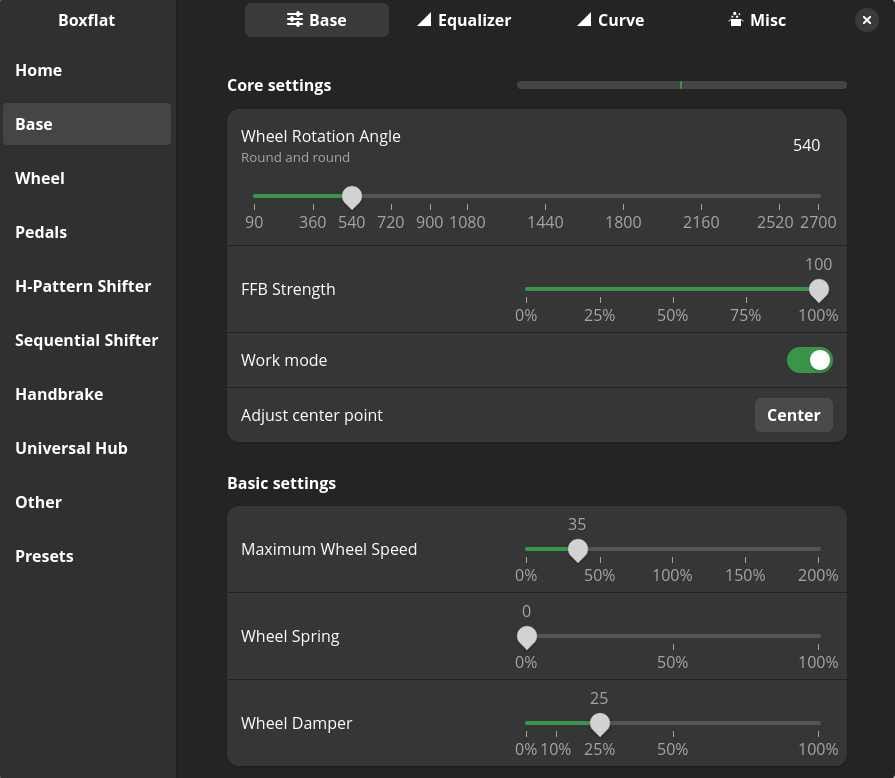
We wanted to adjust our force feedback settings and found Boxflat on Github. It worked a treat, and force feedback was perfect.
Final thoughts
Our foray into Linux was relatively positive, with basically everything we needed working, albeit with some tinkering and lots of Googling. Our main issue was the frame rate felt a bit off, but besides that, running LMU on Linux was definitely doable.
We tested with version 1.2 of LMU, but since the release of V1.3, a newer version of Proton must be installed, or the game won't load a session.
The frame rate issue was what got us to move back to Windows 11, but this initial experience with LMU on Linux gave us hope that we may eventually switch permanently to Linux.
UPDATE 23 August 2026:
The frame rate issue appears to be fixed. We can't be sure what fixed it exactly but since this article was initially published, Nobara has been updated to version 44. That could have been the reason, or maybe the latest version of the Mesa driver cured the issue. Either way, it's running smoothly, as you can see in the video below.
LMU 1.4 on Nobara 44 running smoothly, without the frame pacing issue
It must also be noted that the other sim we play a lot of is iRacing, and that does not work on Linux, mainly due to the anti-cheat software not having support for Linux.
Overall, we rate sim racing on Linux, especially LMU, as a positive experience and hopefully, more racing sims, especially iRacing can be played on it in the future.
